
Goldmind
Black Economics:
Ownership, Circulation, and PowerNomics
Goldmind Pillar 3 of 6
Knowledge and pride without capital eventually run out of runway. Economics is where ideas become assets, ownership, and generational transfer.
Foundation
Why Black Economics Is a Goldmind Pillar
Knowledge and pride without capital eventually run out of runway. Goldmind treats economics as the pillar that converts everything else, including mindset, history, and purpose, into something that compounds: assets, ownership, generational transfer. This isn’t about chasing income. It’s about understanding circulation, ownership structure, and the cooperative models that built wealth before, and can again.
The Record
What Most People Don't Know
-
The racial wealth gap is a gap in assets, not effort.
Federal Reserve survey data has consistently shown that the median white household holds several times the net worth of the median Black household; that gap has remained roughly stable, even as income gaps have narrowed in some sectors. Net worth, unlike income, is built from inherited assets (homes, businesses, investments passed down), which means the gap is structural and historical, not a reflection of current earning or spending behavior.
-
The “Black dollar” doesn’t circulate the way people assume.
Economic studies on dollar circulation within communities have estimated that a dollar spent in many Black communities leaves that community within hours to a few days, compared to much longer circulation times in other communities with denser networks of community-owned businesses, banks, and suppliers. The issue isn’t spending habits; it’s the relatively thin density of Black-owned infrastructure (banks, wholesalers, manufacturers) to circulate the dollar through before it exits.
Underneath It
The Truth No One Teaches
-
Black-owned banks once numbered over a hundred; very few remain.
In the decades following Reconstruction and through the mid-20th century, dozens of Black-owned banks operated across the U.S., providing capital specifically to borrowers redlined out of mainstream lending. Consolidation, discriminatory regulation, and competition from larger institutions reduced that number drastically; today only a small handful of Black-owned banks remain nationally, controlling a tiny fraction of U.S. banking assets despite the much larger Black population they’d need to serve at scale.
-
Cooperative economics has historical proof of concept at scale.
Du Bois studied Black cooperative business and mutual aid societies extensively in the early 1900s, documenting hundreds of mutual aid societies, burial societies, and cooperative stores that functioned as informal insurance and capital-pooling systems decades before most Black communities had access to mainstream credit. “PowerNomics,” a term popularized by Dr. Claud Anderson, builds on this same principle: group economics, vertical integration (producing, processing, and selling within the same community), and intentional, organized buying power.
-
Business ownership rates remain the real gap, more than entrepreneurship interest.
Studies of business formation consistently show that Black Americans start businesses at rates comparable to or exceeding national averages, but those businesses are disproportionately under-capitalized at founding and face higher loan denial rates and higher interest rates when approved, even controlling for credit score, meaning the bottleneck isn’t ambition, it’s access to capital at the founding and growth stages.
The System
How This Connects to the Other Pillars
Economics is where Psychology’s internal locus of control gets tested against real numbers. It’s where History’s interrupted blueprints (Greenwood, Black-owned banks) get studied for what to rebuild and what to do differently. It’s where Motivation has to survive past the excitement phase into the unglamorous, compounding-interest phase.
Hold This
A Closing Thought
Knowledge and pride without capital eventually run out of runway. Economics turns mindset, history, and purpose into assets, ownership, and generational transfer.
Go Deeper
This pillar is explored in full in:
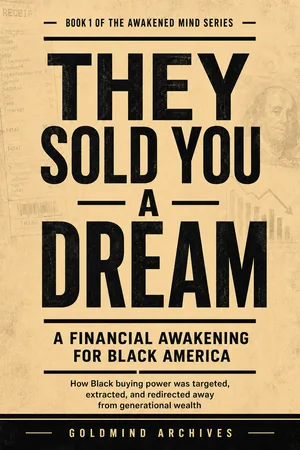 They Sold You a Dream
A Goldmind original examining the economic architecture behind racial wealth gaps, and the only blueprint that takes the full history into account.
Go Deeper
This pillar is explored in full in:
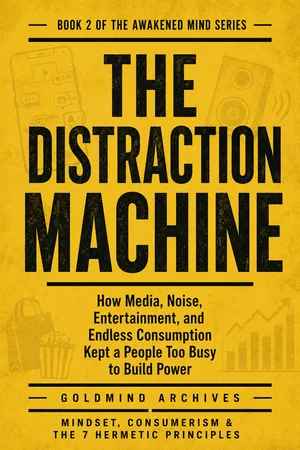 The Distraction Machine
A forensic account of how wealth was extracted, redirected, and legislated away. History as economic instruction. A Goldmind original.