
Goldmind
Black History:
The Record They Tried to Erase
Goldmind Pillar 2 of 6
Goldmind treats history as evidence, not nostalgia. It is the receipts for everything the other pillars are trying to rebuild.
Foundation
Why Black History Is a Goldmind Pillar
A people without an accurate record of their past will always undervalue their own capability in the present. Erasure isn’t just about losing facts; it’s about losing proof. Proof that thriving Black towns existed. Proof that Black-owned banks, hospitals, and school systems were built and functioned at scale before being destroyed by violence or policy. Goldmind treats history as evidence, not nostalgia. It’s the receipts for everything the other pillars are trying to rebuild.
The Record
What Most People Don't Know
-
Black Wall Street was not an isolated case.
Greenwood, the Tulsa district destroyed in the 1921 massacre, is the most widely known example of a self-sufficient Black economic district burned to the ground; historians estimate dozens of Black businesses and over a thousand homes were destroyed in under 24 hours. But Greenwood was one of dozens of thriving Black towns and districts across the country in the same era, including Rosewood, Florida; the Greenwood district itself; and numerous “Freedmen’s towns” founded after emancipation, many of which were also subjected to violent destruction, forced abandonment, or systematic legal obstruction that’s rarely taught alongside the original success story.
-
Black literacy rates rose dramatically in the decades right after emancipation, against enormous odds.
In the years immediately following the Civil War, formerly enslaved people built schools, often from scratch, often illegally during enslavement itself, at a pace historians describe as one of the fastest grassroots literacy movements in American history, despite widespread violence specifically targeting Black schools and teachers during Reconstruction.
Underneath It
The Truth No One Teaches
-
The first self-made female millionaire in America, of any race, is widely credited to a Black woman.
Madam C.J. Walker built a hair care empire in the early 1900s, training thousands of Black women as sales agents and giving many of them their first taste of financial independence, an economic ripple effect that’s often left out when she’s discussed only as a beauty entrepreneur.
-
“40 acres and a mule” was real policy, briefly.
General Sherman’s Special Field Order No. 15 in 1865 actually redistributed coastal land in Georgia and South Carolina to formerly enslaved families. It was reversed by President Andrew Johnson within the same year, and the land was returned to former Confederate owners. This is frequently treated as a folk saying rather than the documented reversal of an actual federal land grant, one of the clearest historical pivot points where wealth-building could have started two generations earlier.
-
Redlining’s effects are measurable in wealth gaps today, not just in old maps.
Studies comparing historically redlined neighborhoods (areas the federal Home Owners’ Loan Corporation marked as “hazardous” for lending in the 1930s) to non-redlined neighborhoods just blocks away consistently show lower home values, lower homeownership rates, and worse health outcomes persisting eight decades later, a direct, traceable line from a single federal map to present-day net worth.
The System
How This Connects to the Other Pillars
History gives Psychology its evidence (you weren’t always treated this way; something was done, and it can be undone). It gives Black Economics its blueprint (Greenwood and Walker’s enterprise are proof of concept, not theory). It gives Motivation its fuel, not as grievance, but as instruction.
Hold This
A Closing Thought
Goldmind treats history as evidence, not nostalgia. It is the proof of what was built, what was taken, and what can be rebuilt.
Go Deeper
This pillar is explored in full in:
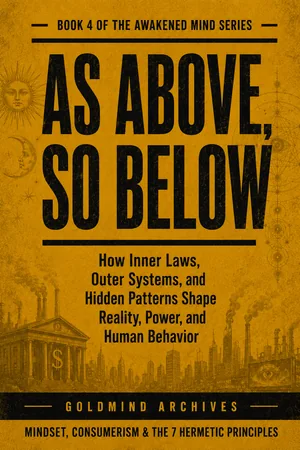 As Above, So Below
The long record. No shortcuts, no surprises. A Goldmind original tracing the complete historical arc so you can locate yourself on the map.